I recently volunteered at two school events to talk about what I do as a data scientist and what you study to become one. One invite came from an academy, where I spoke to Year 1 and 2. The other came from a secondary school, where the audiences were Year 7 and 8, and Year 12 and 13. The same job, explained to a six-year-old, a twelve-year-old, and someone choosing between GCSE and A level subjects.
Part of my talk was a running example: sorting sweets with a classification model. It mostly worked. Where it went wrong taught me something I should have known already — and it turned out to be the best data science lesson in the room.
Starting with the job, and a Boolean question
The first slide I presented was this one — what my job actually looks like, stripped of jargon.
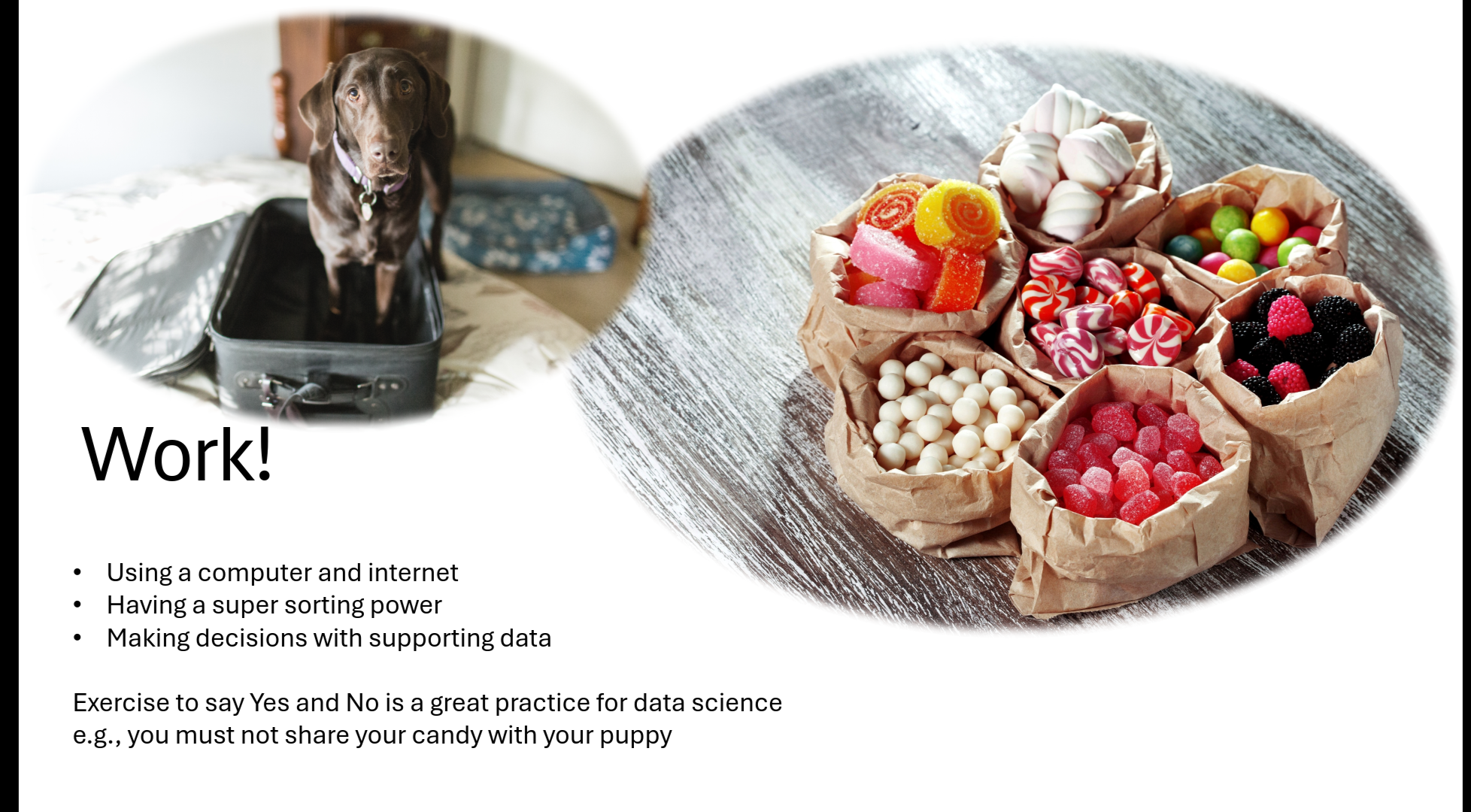
- Using a computer and the internet
- Having a super sorting power
- Making decisions with supporting data
“Super sorting power” is not a bad one-line job description for classification, honestly.
I put a binary classifier first, because a Boolean answer is the simplest possible model output: can I share this packet of sweets with a dog? Yes or no.
Chocolate is toxic to dogs, so anything chocolate gets a hard No. The answer isn’t a matter of opinion — it comes from evidence about what theobromine does to dogs. That’s the third bullet point doing its work: making decisions with supporting data. (And for the record, the safe answer for the fruit gummies is also no — but the point was that the model draws a line, and the line comes from data, not vibes.)
For Year 1 and 2 at the academy, that was the whole lesson: a machine can learn to answer yes-or-no questions, and the answers have to come from evidence, because a wrong answer here really hurts someone (or some dog).
Extending to a multi-class classifier: candy or chocolate?
From there I aimed to extend the example with a second classifier. Instead of two answers, sort everything on this slide — things they’d all recognise from the corner shop — into classes: candy or chocolate.
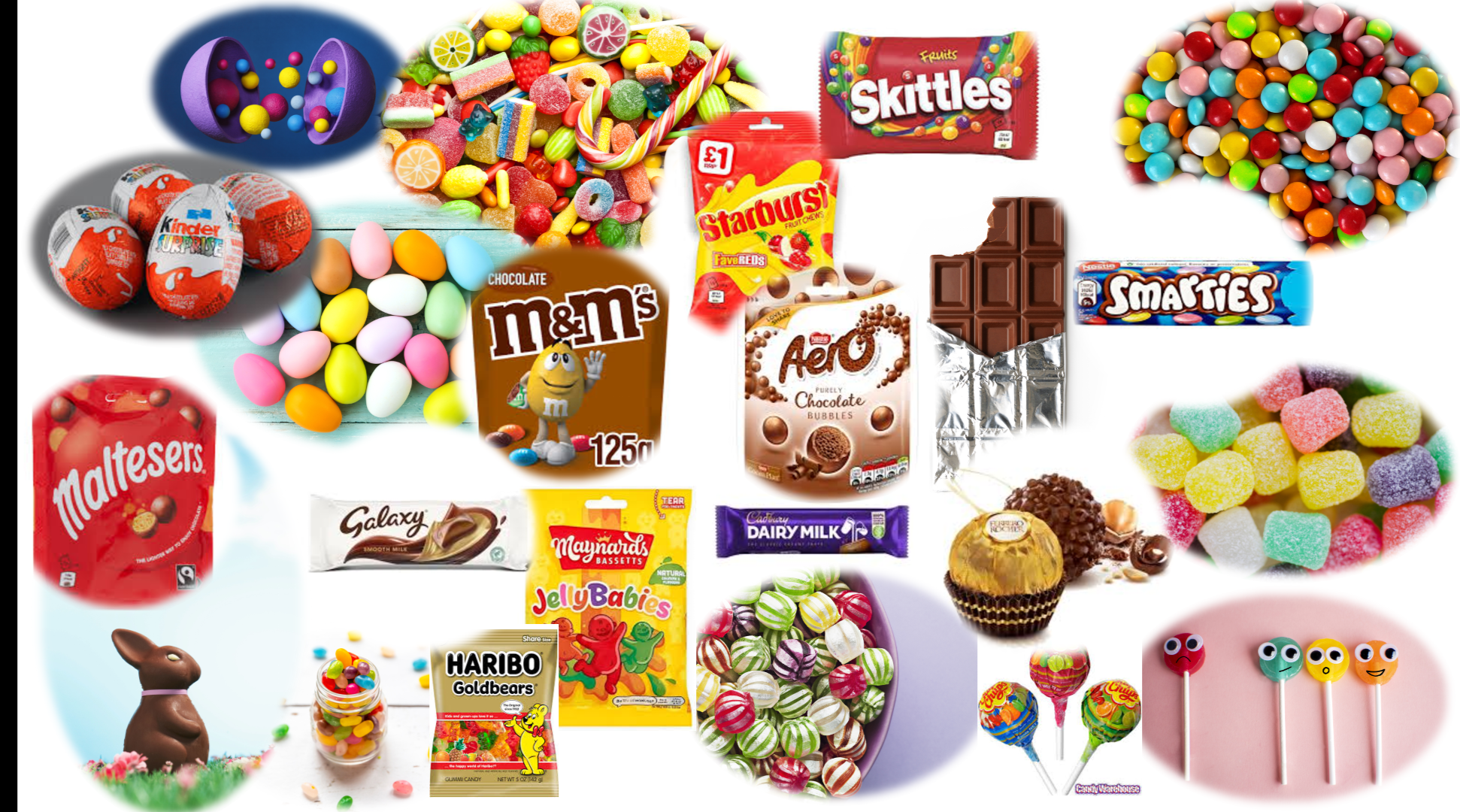
Skittles go one way, Aero goes the other, and then you hit the fun edge cases: what about chocolate-covered things? M&M’s? A Kinder Surprise, which is chocolate wrapped around a toy? I led the class talking about ambiguous examples, fuzzy class boundaries, and who gets to decide the ground truth — which is most of applied machine learning, delivered via a bag of Haribo.
With Year 12 and 13 that opened the door to the “what do I study for this” conversation: maths and statistics for the decision boundaries, computing for the pipelines, and — as I was about to inadvertently demonstrate — a lot of careful thinking about how you define your labels in the first place.
Then a new label: what if the model wasn’t trained for Haribos?
The last step of the arc was my favourite question: what happens when the model meets something it wasn’t trained for? Haribos are neither chocolate nor, really, candy-the-hard-sugary-kind. A two-class model has nowhere to put them — it will confidently shove a Goldbear into whichever class is nearest, and be wrong.
So I introduced a third label, “jelly”, for the Haribo-type gummies — to show that sometimes the right fix isn’t a better model, it’s admitting your label set doesn’t cover the world.
Good idea in principle. In practice, it added a second layer of confusion on top of one I’d already created without noticing.
Where my labels didn’t sync with the room
Here’s what I got wrong, and I didn’t notice until afterwards.
“Candy” is not the word. I’d built the taxonomy around candy vs chocolate — but British pupils don’t say candy. They say sweets. Candy is what American YouTube says; sweets is what you ask for at the corner shop. Every time I said “candy,” there was a tiny translation step happening in the room that I hadn’t budgeted for. My class labels were in the wrong dialect.
“Jelly” made it worse. The new label I’d introduced to fix the coverage gap collided with an existing meaning: in a British school, jelly means the wobbly dessert — the 🍮 pudding-bowl kind that comes with ice cream at a birthday party. So when I said “these go in the jelly class,” a fair chunk of the room pictured a dessert bowl, not a Goldbear. The younger pupils and the sixth formers alike were quietly resolving my labels against a different ontology.
The class didn’t fall apart — children are generous, and sweets on a slide buy you a lot of goodwill. But the labelling scheme and the audience’s vocabulary never fully synced, and I was the last person in the room to realise it.
The accidental lesson: label taxonomy is a localisation problem
The irony is that this is exactly the kind of failure I deal with professionally. I stood in front of three year groups explaining that classifiers are only as good as their labels — while using labels that didn’t match the domain vocabulary of my users. Even the part of the talk about incomplete label sets introduced a label with the wrong meaning.
A few things I’d tell past-me before the next school visit:
1. Labels are user-facing vocabulary, not internal convenience. If the people consuming your classifier’s output call the thing sweets, your class is called sweets, not candy. This is the same discipline as matching clinical terminology in health data: the label set has to come from the domain, not from the modeller’s head.
2. Test your taxonomy on a native speaker of the domain. Five minutes with any British eight-year-old — or honestly, any British colleague — would have caught both problems. That’s a label review, and it’s cheaper than discovering the mismatch live in front of Year 2.
3. Ambiguous labels don’t just confuse models — they confuse annotators. If I’d asked the pupils to sort the collage themselves (which would have been a great activity), the jelly class would have collected inconsistent items depending on what each child thought jelly meant. That’s exactly how noisy training labels happen in real projects: not from carelessness, but from a label name that means different things to different annotators.
4. The corrected taxonomy was sitting on my own slide. Sweets / chocolate / and, for the not-trained-for class, gummies or just Haribo — a brand name that every child in Britain resolves to precisely the right concept. The best label is the one your users already use.
What I’d run next time
The talk I want to give next time is the same talk, with one change: hand the sorting to the room. Give each table the collage, ask them to invent their own class names, and compare the taxonomies between tables. Year 1 will produce “yummy / super yummy”. Year 8 will argue about whether a Kinder Surprise is chocolate or a toy. Year 12 will reinvent hierarchical classification without being told.
And every one of those outcomes teaches the real lesson better than my slides did: before you train the model, agree on what the labels mean — with the people who’ll actually use them.
The dog still doesn’t get any chocolate, though. Some classifications are non-negotiable.